

Learn why DStv pixelates during KwaZulu-Natal storms, what causes rain fade, and how correct dish alignment keeps your signal stable.
If your DStv picture breaks up every time a KwaZulu-Natal storm rolls in, you are dealing with something called rain fade. It is one of the most common signal complaints in the province, and the good news is that most of it comes down to how well your dish is set up. This guide is written with Queensburgh homes in mind. If you are in Queensburgh, the same principles apply, and our technicians work in the area regularly.
Table of Contents
- What Rain Fade Actually Is
- Why Some Homes Handle Storms Better
- How to Fix Persistent Pixelation
- When to Call a Technician
- Signal Margin and Why It Matters
- How Installer DStv Can Help
- Frequently Asked Questions
What Rain Fade Actually Is
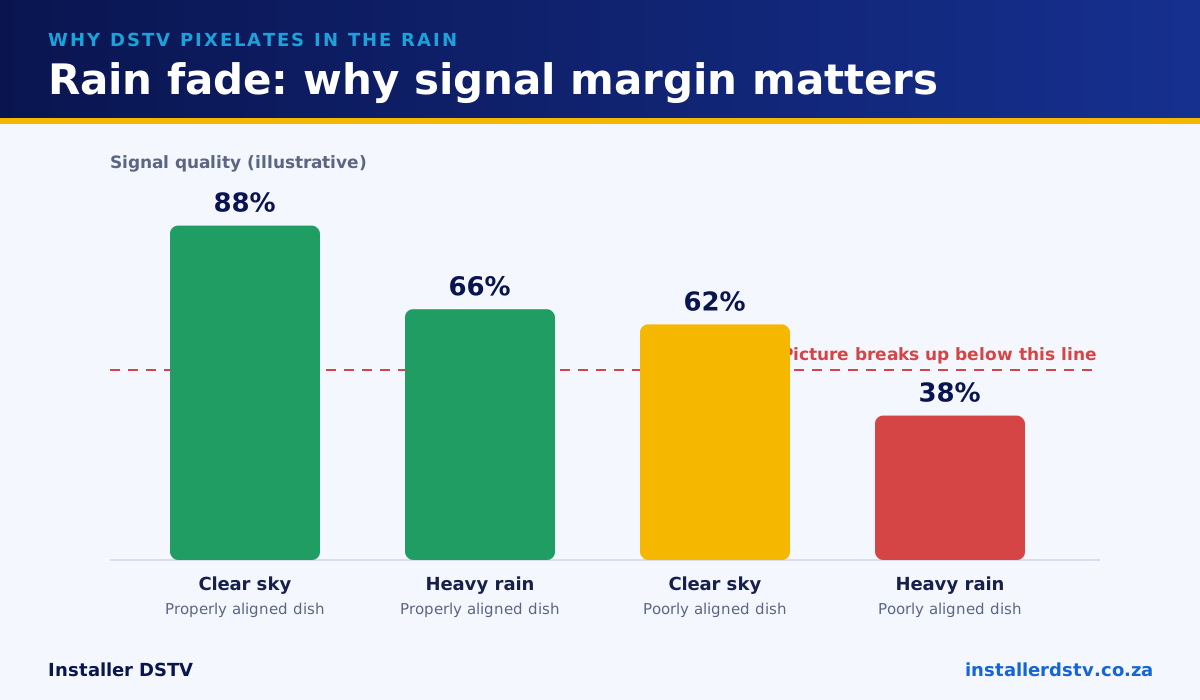
Rain fade happens when heavy rain in the atmosphere absorbs and scatters the satellite signal on its way down to your dish. Because DStv uses a high frequency Ku band signal, it is especially sensitive to thick cloud and heavy downpours, which is exactly the kind of weather KwaZulu-Natal gets through summer.
A small amount of signal loss during a serious storm is normal and affects everyone. The problem is when your picture breaks up in light rain or takes ages to come back after a storm passes. That points to a setup that has very little signal margin to spare.
Why Some Homes Handle Storms Better
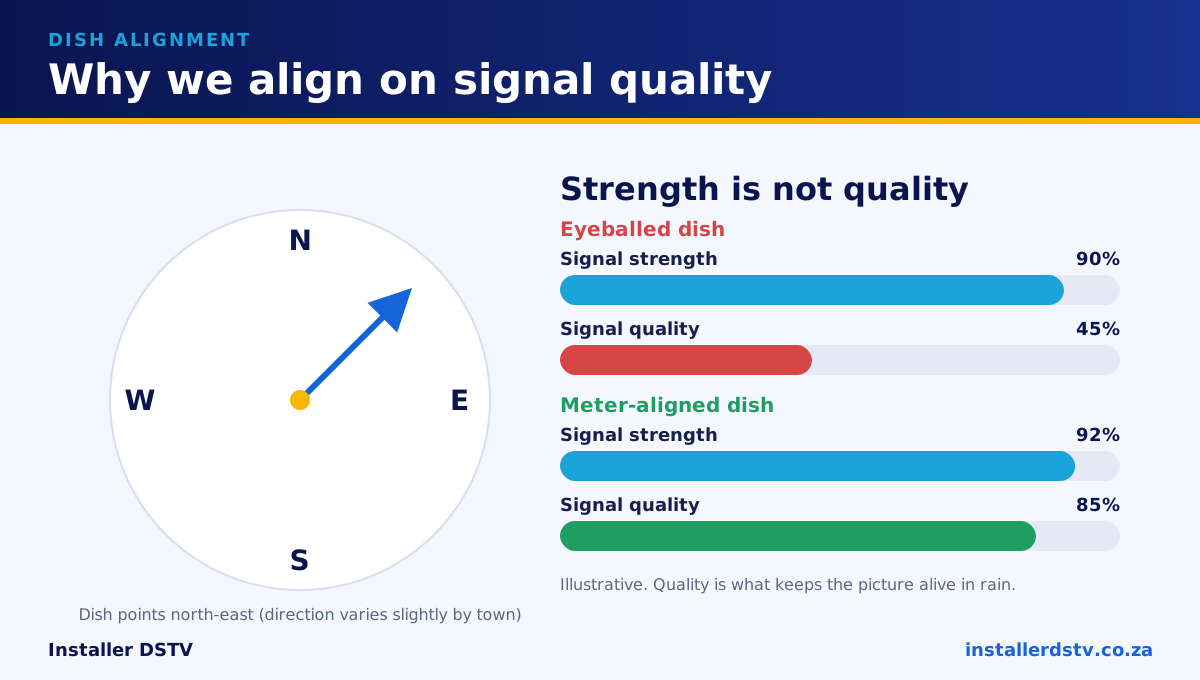
The difference usually comes down to alignment. A dish that is aimed precisely at the satellite receives the strongest possible signal, which gives it a healthy buffer to lose during bad weather. A dish that is even slightly off starts with a weaker signal, so it drops out far sooner.
Other factors include the condition of the LNB, the quality of the cabling, and how well the connections are sealed. Water creeping into a poorly sealed connector will cause exactly the kind of intermittent fault that gets worse in the rain.
How to Fix Persistent Pixelation
If your picture breaks up in anything more than a heavy storm, the first step is a proper signal check. A technician measures your signal strength and quality, realigns the dish for the best reading, and inspects the LNB and cabling for faults.
In many cases a simple realignment and a fresh set of sealed connections transforms a temperamental setup into one that rides out storms with ease.
When to Call a Technician
You can safely check that your cables are firm and that nothing has physically knocked the dish. Beyond that, climbing onto a roof and aligning a dish with a signal meter is best left to a professional, both for safety and for accuracy.
If pixelation is a regular frustration in your home, a signal repair visit is almost always worth it, because it fixes the root cause rather than leaving you to suffer through every storm.
What This Means for Queensburgh
Queensburgh, a collection of quiet residential suburbs in the Outer West, has its own local factors. The valley terrain sometimes needs a higher mounting point for clear line of sight.
Our team covers Queensburgh and across KwaZulu-Natal, so if any of this applies to your home, help is close by. We know the area around Malvern, Escombe, and the surrounding valleys and the kinds of homes here, from freestanding family homes, older houses, and complexes.
Signal Margin and Why It Matters
Think of signal margin as a reserve tank. On a clear day your dish might receive far more signal than the decoder strictly needs, and that surplus is your margin. When rain absorbs part of the signal, you simply dip into the reserve and the picture carries on.
A poorly aligned dish has almost no reserve, so even light rain pushes it below the level the decoder needs. This is why two homes on the same street can have completely different experiences during the same storm. The one with a properly aligned dish barely notices, while the other loses the picture entirely. Building that margin back is exactly what a signal repair visit does.
How Installer DStv Can Help
Installer DStv works across Queensburgh every week, and our accredited technicians deal with exactly this kind of thing day in and day out. Whether you need a quick signal check, a full installation, or honest advice on the best setup for your home, we bring the local knowledge and the right equipment to get it done properly.
We believe in transparent quotes, genuine components, and workmanship that lasts, because a job done right the first time is what earns trust and keeps customers coming back. If anything in this guide sounds familiar, a short conversation with our team will point you in the right direction.
Frequently Asked Questions
Will this affect my DStv subscription?
No. This is about the installation and signal side of things, which is separate from your subscription. Your account and channels stay exactly as they are.
How quickly can a technician help in Queensburgh?
In many cases we can arrange a same day or next day callout for Queensburgh and nearby areas, depending on availability on the day.
Is it worth calling a professional?
Yes. A professional finds the real cause the first time, uses genuine parts, and tests the result, which saves you money and repeat callouts in the long run.
Need help in Queensburgh? Contact Installer DStv for expert advice and accredited service across Queensburgh and across KwaZulu-Natal.