

A simple explanation of how DStv satellite signal travels from space to your decoder, and why dish alignment matters so much.
Ever wondered how a picture beamed from a satellite thousands of kilometres up ends up on your television? Understanding the basics helps you see why a good installation matters so much. Below we look at what it means for homes in Glenwood specifically. If you are in Glenwood, the same principles apply, and our technicians work in the area regularly.
Table of Contents
- From Satellite to Dish
- The Job of the LNB
- Down the Cable to Your Decoder
- Why Every Link Matters
- Common Points of Failure
- How Installer DStv Can Help
- Frequently Asked Questions
From Satellite to Dish
DStv broadcasts are beamed from a satellite in a fixed position high above the equator. Your dish is a curved reflector that catches this faint signal and focuses it onto a single point, which is where the LNB sits.
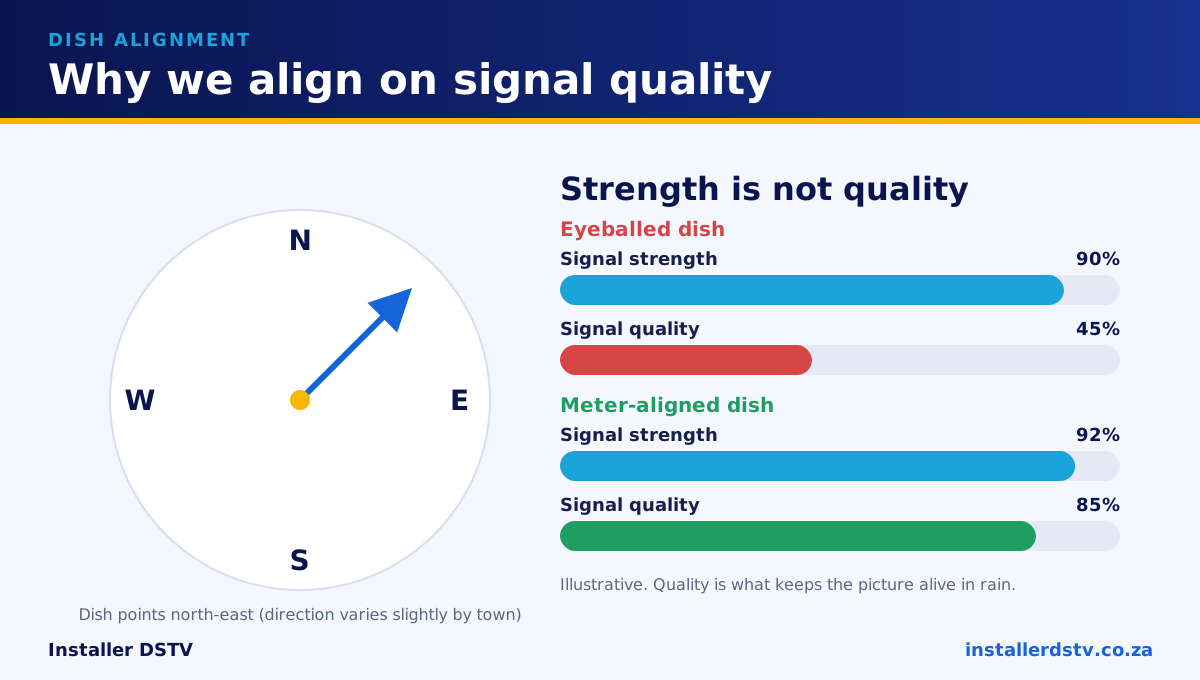
Because the satellite is in a precise spot in the sky, your dish has to be aimed at it accurately. Even a small error means the dish catches far less signal, which is why alignment is so important.
The Job of the LNB
The LNB, mounted on the arm of the dish, takes the focused satellite signal, amplifies it, and converts it to a frequency that can travel down a coaxial cable to your decoder.
The type of LNB fitted also decides how many decoders you can run. A Smart LNB, for example, supports multiroom setups that older single LNBs cannot handle.
Down the Cable to Your Decoder
From the LNB, the signal travels along coaxial cabling into your home and into the decoder. Good quality cable and properly crimped, sealed connectors keep that signal strong along the way.
The decoder then unscrambles the signal using your smartcard and subscription, and turns it into the channels you see on screen.
Why Every Link Matters
A DStv system is only as strong as its weakest link. A perfect dish means little if the cabling is water damaged, and a great decoder cannot fix a dish that is out of alignment.
That is why a professional installation treats the whole chain as one system, from the dish right through to the decoder, so every part is doing its job.
What This Means for Glenwood
Glenwood, a trendy, bohemian suburb near the university, has its own local factors. Older roofs and heritage homes need gentle, tidy installation work.
Our team covers Glenwood and across KwaZulu-Natal, so if any of this applies to your home, help is close by. We know the area around Davenport Road, the cafes and galleries, and the university precinct and the kinds of homes here, from restored old houses, student digs, and cottages.
Common Points of Failure
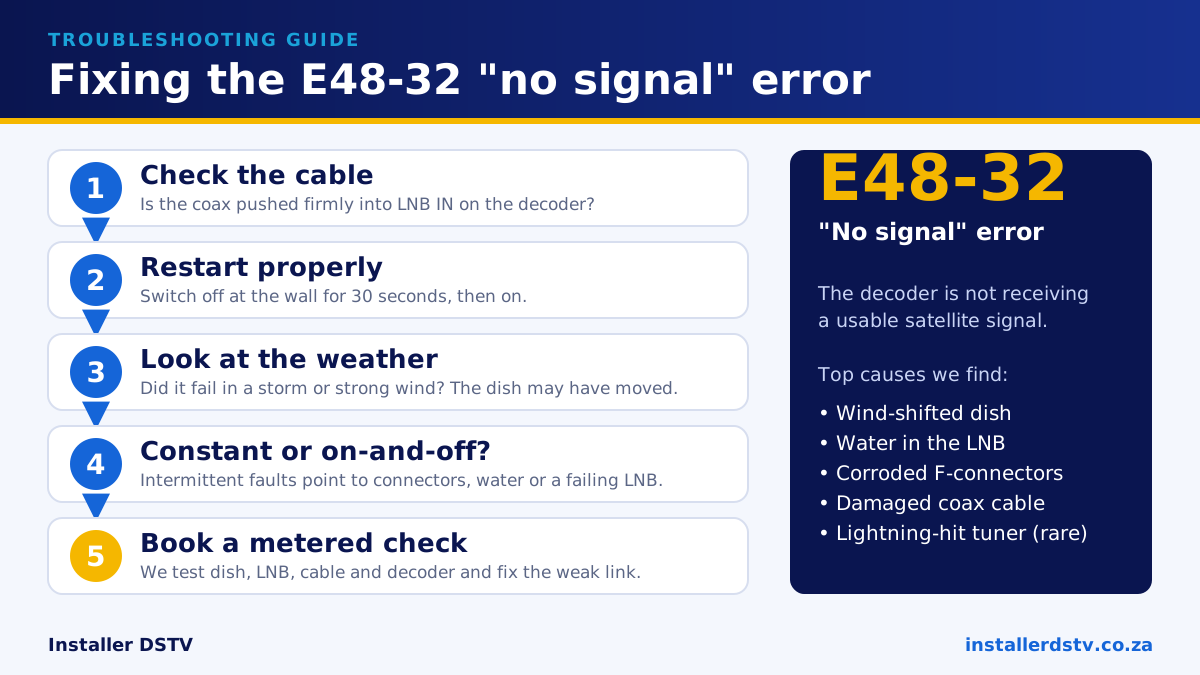
Because a DStv system is a chain, it is useful to know where that chain tends to break. The dish can drift out of alignment, the LNB can fail or corrode, the cabling can let in water, and connectors can work loose or rust.
Each of these weakens the signal in its own way, and often the symptoms look identical from the couch, just a picture that breaks up or disappears. That is why a proper diagnosis checks each link in turn rather than assuming the cause. Understanding this makes it clear why a rushed job that skips the testing step so often leads to problems later.
How Installer DStv Can Help
Installer DStv works across Glenwood every week, and our accredited technicians deal with exactly this kind of thing day in and day out. Whether you need a quick signal check, a full installation, or honest advice on the best setup for your home, we bring the local knowledge and the right equipment to get it done properly.
We believe in transparent quotes, genuine components, and workmanship that lasts, because a job done right the first time is what earns trust and keeps customers coming back. If anything in this guide sounds familiar, a short conversation with our team will point you in the right direction.
Frequently Asked Questions
Can I fix this myself?
You can safely handle simple checks such as rebooting the decoder and making sure cables are firm. Anything involving the dish, the LNB, or roof work is best left to a professional for safety and accuracy.
Will this affect my DStv subscription?
No. This is about the installation and signal side of things, which is separate from your subscription. Your account and channels stay exactly as they are.
Is it worth calling a professional?
Yes. A professional finds the real cause the first time, uses genuine parts, and tests the result, which saves you money and repeat callouts in the long run.
Need help in Glenwood? Contact Installer DStv for expert advice and accredited service across Glenwood and across KwaZulu-Natal.